THE NATIONAL OBSERVER
"All the News
That's Fit to Print"
That's Fit to Print"
The New York Times
Late Edition
All 45 Presidents Found Alive and Young Again in Unprecedented Global Event
Congress Repeals 22nd Amendment Within Weeks; Several Former Leaders Signal Interest in 2028 Race
WASHINGTON — In what scientists, theologians and world leaders are calling the most significant event in recorded human history, all 45 former Presidents of the United States were discovered alive earlier this month, each restored to the approximate age and physical condition they held on the day of their first inauguration.
The phenomenon, which appears to have occurred simultaneously at approximately 3:17 a.m. Eastern time on November 1, has defied every attempt at rational explanation. Each president materialized at the site of their original inauguration — most on the steps of the U.S. Capitol, though George Washington was found standing at Federal Hall in Lower Manhattan, visibly bewildered but reportedly in excellent health.
"I have seen many things in my years of service to this republic," said Abraham Lincoln, appearing gaunt but vigorous on the East Portico, "but I confess this morning has tested even my capacity for wonder." Mr. Lincoln, who would have been 217 years old, appears to be approximately 52 — his age when first sworn in during the crisis year of 1861.
The White House confirmed the identities of all 45 individuals through DNA analysis, dental records where available, and extensive biographical interviews conducted by teams from the F.B.I. and the Smithsonian Institution. President Trump addressed the nation from the Oval Office that evening.
"Nobody's ever seen anything like this, okay? Nobody," Mr. Trump said. "And look, some of these guys were fine — not great, but fine. Lincoln? Overrated. FDR couldn't even walk. And now I'm supposed to be worried? I beat everybody the first time, I beat everybody the second time, and I'll beat all 45 of them at once if I have to. Frankly, most of them wouldn't even know how to use a phone."
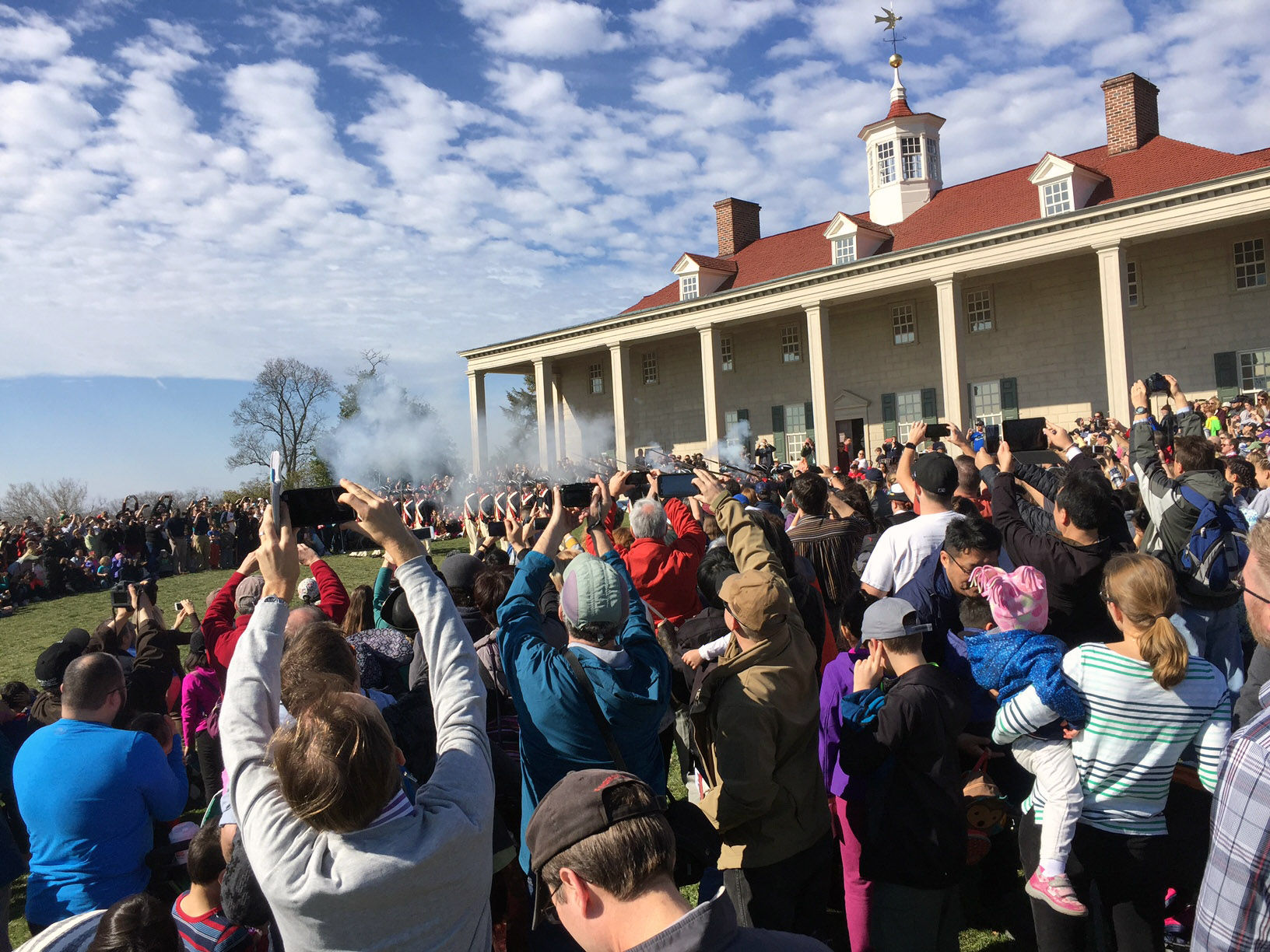
Crowds flock to Mount Vernon to celebrate George Washington's return. Thousands gathered on the grounds of the first president's estate, many traveling from across the country. Ryan Jones/Associated Press
The Vatican issued a rare emergency encyclical within 48 hours. Pope Leo XIV — the first American to hold the papacy — called the event "a mystery belonging wholly to the Author of all life" and urged the faithful to receive the returned leaders "with humility and an open heart." Spontaneous prayer vigils erupted in cities across the globe.
Congress acted with a speed rarely seen in modern Washington. Within three weeks, both chambers voted overwhelmingly to repeal the 22nd Amendment, which had limited presidents to two terms since its ratification in 1951. The measure passed the Senate 91-9 and the House 401-34, with ratification by the required 38 state legislatures completed in a record 11 days.
"How do you tell Abraham Lincoln he can't run?" said Senator Tom Cotton, Republican of Arkansas, who co-sponsored the repeal. "How do you tell Franklin Roosevelt? The American people deserve the right to choose from among the greatest leaders this nation has ever produced."
Not all returned presidents have expressed interest in re-entering politics. Several, including James Buchanan and Warren G. Harding, have indicated a preference for private life. William Howard Taft reportedly asked first about the current composition of the Supreme Court.
But a striking number have already signaled their intention to contest the 2028 presidential election, setting up what historians are calling the most consequential campaign in American history.
Franklin D. Roosevelt has re-established himself at his Hyde Park estate and begun assembling what advisers describe as a "21st-century coalition." Abraham Lincoln, rail-thin and tireless, has drawn enormous crowds. John F. Kennedy held a packed rally in Boston, while Lyndon B. Johnson told reporters in Austin, "I didn't finish what I started." Barack Obama, one of the few returned presidents who had already been living, formally announced his candidacy from Chicago.
Ronald Reagan delivered a speech at the Reagan Library that drew 40,000 attendees and was described by allies as "vintage." Dwight D. Eisenhower, appearing fit and commanding, announced from Abilene, Kansas. Theodore Roosevelt has generated enormous social media attention — aides say he has taken to the internet "like a Rough Rider to horseback." Donald Trump, the sitting president, has told advisers he views the returned leaders as "competition, not colleagues." Andrew Jackson's announcement, delivered on the steps of the Hermitage, was characteristically blunt.
Perhaps most closely watched is George Washington, the only president to have never belonged to a party. "I warned against the spirit of faction in my farewell address," the first president said in a rare public statement. "I see no reason to revise that counsel." Thomas Jefferson, meanwhile, told supporters that the modern federal government had become "precisely the tyranny we revolted against."
Pollsters are struggling to model a race unlike anything in history. A preliminary survey by The New York Times and Siena College found that 78 percent of Americans view the return as "a miracle or act of divine intervention," while 12 percent suspect advanced technology and 10 percent remain unsure.
"Every model we have is useless," said Nate Cohn, the Times's chief political analyst. "We're starting from scratch."
The campaign is expected to officially begin in the coming months, with the first primary contests scheduled for early 2028. The nation — and the world — will be watching.
Continued on Page A14
Select Your Candidate
Drag logos between parties to reassign · Click a logo to configure
Major Party Primaries
 Democratic Party
 Republican Party
Third Party / Independent
 Libertarian Party
 Green Party
Independent
Starting Polls
Load Saved Game
Select a saved campaign to continue
Your Saved Campaigns
How to Play
Your complete guide to winning the White House
1 · The Goal
You are running for President of the United States. The campaign runs across 26 rounds, moving from the pre-primary season, through the party primaries and nominating conventions, and into the general election. To win you must secure 270 of the 538 electoral votes on Election Night. If no candidate reaches 270, the race is decided by a contingent election in the House of Representatives.
2 · Choosing Your Candidate & the Field
On the Select Your Candidate screen you decide who runs, for which party, and who you control:
- Pick who you play. Click a candidate's logo to configure them. Set their control to Player to take the reins; everyone else is run by the AI.
- Decide who is running. Each candidate can be toggled between running and sitting the cycle out. Only running candidates appear in the primaries and polls.
- Assign parties. Drag a candidate's logo between the Democratic, Republican, and third-party groups to reassign which primary they compete in. You can run as a major-party contender or strike out as a third-party / independent candidate.
- Multiple humans. More than one candidate can be set to Player for hot-seat play; the game cycles the active player each turn.
When at least one candidate is set to Player, the Start Game button unlocks.
3 · Hire an Advisor (highly recommended)
Right after setup you may hire a campaign advisor. This is the single best way to learn the game: throughout the entire campaign your advisor delivers hints, strategic context, and a suggested resource-allocation plan every round — which states to target, which ads to run, which policies to release, and who to attack. You can accept the whole plan with one click or use it as a starting point. New players should always take an advisor; you can still override every suggestion yourself.
4 · Your Turn: Allocating Resources
Each round your turn is organized into three steps. You have 5 personal actions per round (your time) plus your campaign cash (limited only by your bank balance).
Step 1 — Gather Data (Polling)
Buy polls to see where you stand before you commit. Options include national and state polls, policy-approval polls, and a constituency trust poll. Information is cheap compared to wasting a whole round's budget on the wrong move.
Step 2 — Set Your Schedule (Personal Actions)
Spend your 5 actions on high-impact personal appearances. Each has a distinct effect:
- Major Speech ($500k, in a chosen state) — promotes one of your aspects (raising approval / lowering "unsure") and optionally attacks one opponent aspect. It also nudges turnout in that state your way, and the topic you speak on gets emphasized in the media (see below).
- Small Event ($100k, in a chosen state) — a modest, reliable local turnout bump — smaller than a speech but cheap and low-risk.
- Debate Prep ($100k) — before a debate, makes the best answers and safest attacks clearer during the minigame and improves your showing.
- Fundraiser ($100k) — raises your income for the following round; the payoff scales with your national poll standing, so it's worth more as you climb.
- Seek Endorsement (free) — court party endorsers, state bosses, and policy champions. Endorsements convert voters to your side and pay recurring income every round (party endorser ≈ $100k, state boss ≈ $500k, policy champion ≈ $1M each).
- Earned Media (free) — spotlight one policy topic to emphasize it in the national conversation. The number of emphasis points you get scales with your Charisma, so a charismatic candidate shapes the agenda for free.
Step 3 — Invest in Your Campaign (Money)
Cash actions are unlimited so long as you can pay for them. The bigger the audience an ad reaches, the bigger its effect — and its price:
- Ground Game (per state) — organizers that convert that state's persuadable voters into definite turnout for you. The most cost-effective way to bank votes in states voting soon; cost varies by state and is capped per state.
- Positive Ad ($1 per voter reached) — raises approve and lowers unsure on one of your own aspects — a perceived trait or a specific policy. A policy ad is ideology-aware: it lands with the ideologies that like that policy.
- Negative Ad ($1 per voter reached) — drives up an opponent's disapprove on a chosen aspect. Attacking a perceived trait (Strength, Character, Intelligence) also splashes onto their Charisma — but attacks can backfire if you're weaker on the issue than your target.
- Policy Release ($100k) — formally stake out a position on an issue. It sharply boosts approval on that policy for the ideologies that favor it, and undercuts rival positions on the same topic. You can only release a given policy once.
- Communications Team — steadily raises your Charisma approval each round it's staffed.
- Political Team — general campaign capacity used to fund and enable your operations.
- Finance Team — increases the money you raise every round.
Actions you choose in Steps 2 and 3 are queued. Nothing is spent until you press Submit Budget, so you can review and cancel freely first. Need cash back? Reallocate Resources lets you downsize teams or ground game for a 50% refund.
5 · How Voters Decide (the heart of the game)
Every voter belongs to an ideology (from progressive to populist to libertarian and beyond). Whether they approve of you comes down to two very different kinds of trait:
Perceived traits vs. ideological positions
- Perceived traits — Charisma, Strength, Character, and Intelligence. These are how voters see you as a person, and they read the same to every ideology. A likeable candidate is likeable across the board.
- Ideological / policy positions — your stance on the ~15 policy topics. These are judged through each ideology's eyes: a position that thrills progressives may repel populists. Only the policies an ideology actually cares about count toward how that group rates you.
Your approval with a group blends the two, but leans heavily on policy — roughly three parts policy alignment to one part personal impression. Being charming won't save you if your platform is wrong for the voters you need; a perfect platform still benefits from a strong personal image.
Why Charisma is special
Charisma does far more than its share of approval. It powers your Earned Media (more charisma → more free agenda-setting), it's a big part of your debate strength, and it's the trait that catches the splash damage whenever an opponent attacks your other perceived traits. Investing in a Communications Team to build Charisma pays off in several systems at once.
Media emphasis — controlling the conversation
The topics being talked about are weighted more heavily when voters judge you. Speeches, ads, policy releases, debates, and Earned Media all emphasize a topic for a few rounds. If you can make the race about the issues where you're strong, those issues count for more — and your approval rises even if nothing else changes.
From approval to polls to votes
Your approval with each ideology becomes a net approval (approve minus disapprove). Candidates with higher net approval among a group win a bigger share of that group's voters — though even an underwater candidate keeps a sliver of support rather than vanishing. Sum that across every ideology and state and you get your poll numbers. Two important wrinkles:
- Primary polls only count your own party's voters — win over the ideologies that vote in your primary first.
- Turnout matters as much as persuasion. Ground game, endorsements, speeches, and events convert "maybe" voters into definite turnout. A candidate with narrower but more committed support can beat a broadly-liked rival who never banks the votes.
6 · The Primary Schedule
During the primary phase, states hold their contests on a fixed calendar (Iowa and New Hampshire first, a Super Tuesday cluster, and so on). Each contest awards delegates using that state's rules — proportional, winner-take-all, or hybrid. Your job is to build a delegate lead by targeting the states voting soon with ads and ground game. You can review the full calendar from the primary schedule view in-game.
7 · Debates
Debates happen on set rounds — 3, 7, 10, and 15 during the primaries and 21, 23, and 24 in the general election. In the primary phase each party debates separately; in the general it's a head-to-head. Debates are an interactive minigame: you answer the moderator's questions by playing to your strengths and can attack opponents where they're weak — but a poorly chosen attack can backfire. Doing Debate Prep beforehand makes the choices clearer. You may skip a debate, but you'll take a hit to your perceived Strength and collect only half your income that round.
8 · The Convention
After the primaries, each major party holds its nominating convention. Delegates you won are cast in multi-round voting; if no candidate has a majority on the first ballot, trailing candidates are dropped and their delegates redistributed until someone clinches the nomination. Endorsements matter here — they sway how freed-up delegates flow. This is also where you'll lock in your Vice-Presidential pick, which broadens your appeal to the constituencies your running mate is strong with. (Independent and third-party candidates have no convention and pick a running mate directly.)
9 · The General Election
Once nominated, the map resets to a national contest for electoral votes. The final rounds are about the swing states: use the General Election Match-Up map to see projected electoral votes, pour ground game and ads into the states that can flip, and win the closing debates. On Election Night states are called one by one until someone crosses 270 — or, if nobody does, the House decides in a contingent election.
New here? Take an advisor, follow their suggested plan for the first few rounds, and watch how your polls and delegates respond. You'll be running your own strategy in no time.
Actions
Loading actions...
United States Map
Click any state for polls & actions
National Poll
Loading poll...
Poll Trend
Awaiting opening statements...
Round 1: Opening Statements
--
Topic Results
THE NATIONAL OBSERVER
DEBATE NIGHT SHAKES UP THE RACE
📣
Round 1
The Feed
🇺🇸 ELECTION NIGHT 2028
Polls closing...
2028 PRESIDENTIAL ELECTION RESULTS
The American Tribune
November 3, 2028